Unlimited zones
No artificial zone limits and no per-zone licence fees. Installations of 60+ independent zones with separate programming and schedules are in service today.
Limited bandwidth, dozens of distinct zones, thousands of guests with different expectations: cruise ships are the hardest environment in commercial audio. Rosi was engineered for exactly this: multi-zone, offline-capable background music that keeps playing mid-Atlantic, mid-Pacific, mid-anywhere.
A resort hotel with sixty music zones would be considered a flagship installation. On a cruise ship it's a Tuesday. Pool decks, speciality restaurants, spas, casinos, kids' clubs, promenades and lift lobbies all need distinct programming that changes through the day and through the itinerary.
Then the environment fights you. Satellite bandwidth is expensive, contended and routinely unavailable. Standard B2B music services assume a broadband connection that simply doesn't exist at sea. And the stakes are higher: a music outage on a cruise ship isn't an inconvenience, it's a guest experience incident, visible to thousands of guests at once and to the officers responsible for them.
Cruise directors need override control for sail-aways and events. Head office needs fleet consistency. IT needs something that won't eat the VSAT link. Most music providers can satisfy one of those parties. We built for all three.
No artificial zone limits and no per-zone licence fees. Installations of 60+ independent zones with separate programming and schedules are in service today.
Music plays from local vessel storage. The satellite link is used for updates and reporting only, so playback never depends on it.
Weekly content refreshes arrive as compressed, deduplicated delta packages, typically a few megabytes, scheduled around your link's quiet hours.
Music adjusts automatically to destinations, sea days and themed voyages. The Caribbean leg and the transatlantic crossing don't have to sound the same.
One shore-side dashboard across every vessel, with per-ship and per-zone control, monitoring and reporting for shore teams.
Direct access to the engineers who built the platform, not a first-line script. Integration support for your AV and IT teams throughout.
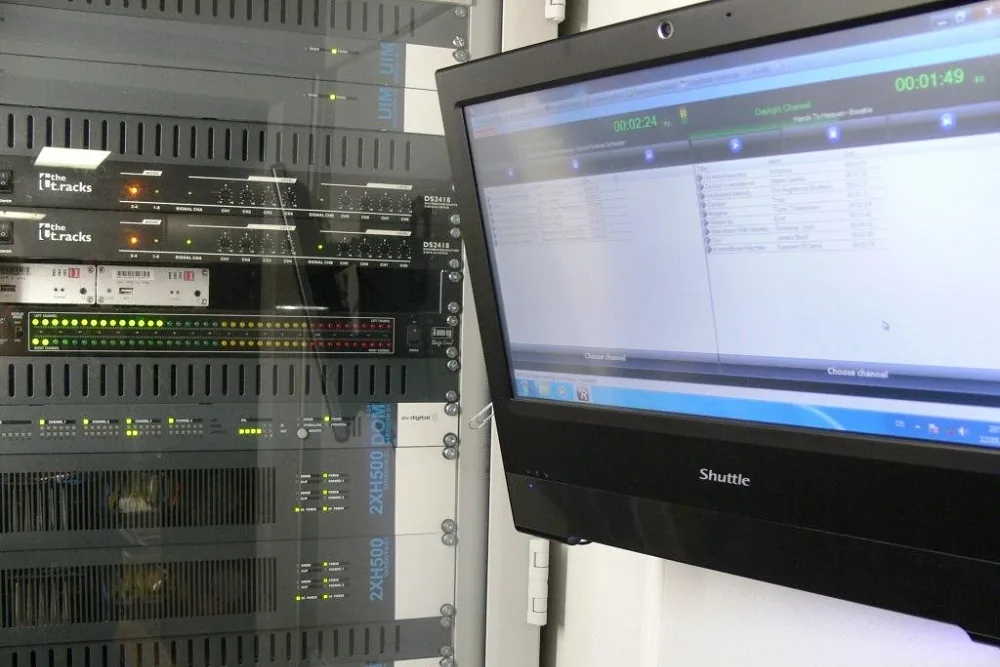
Each vessel carries a complete local copy of its music library, encrypted at rest. Playback machines run as services on standard hardware in your technical spaces, feeding your existing audio infrastructure. We output to Dante, analogue or AES3, so there's no proprietary hardware and no speaker replacement, on new-builds or retrofits.
The satellite link carries only what it must: compressed, deduplicated delta updates (typically a few megabytes, not gigabytes) and play-out reporting back to shore. If the link drops for a day or a week, every zone keeps playing to schedule.
Programming is itinerary-aware: Caribbean afternoons, Norwegian fjord mornings and themed voyages can each carry their own sound automatically. Cruise directors keep manual override for events, and complete play-out logs support fleet licensing reconciliation.
We know cruise procurement is a multi-stakeholder evaluation: operations, guest experience, IT and procurement all get a say. The pathway is built for it.
A 60-90 minute session under NDA: architecture, licensing model, integration options and honest answers about fit.
Full specifications, security documentation and references for your IT, AV and procurement teams to evaluate.
Typically three months on a single vessel with agreed success criteria. Pilot costs are credited against a fleet rollout.
Coordinated with dry-dock schedules and operational priorities, vessel by vessel, with shore-side training included.
Yes, indefinitely. The complete library lives on the vessel, and every zone plays to its schedule with zero connectivity. The satellite link only carries content updates and reporting when it happens to be available.
No. Rosi outputs to Dante, analogue and AES3, feeding whatever PA and zone amplification the vessel already carries. It suits new-builds and retrofits alike, with no proprietary hardware.
Fleet-level licensing is typically the operator's responsibility and varies by flag state and itinerary. What we provide is complete play-out logging per vessel and per zone, which makes licensing reconciliation straightforward for your legal team.
Yes, via role-based override from web or mobile apps. A sail-away party can take over the pool deck in seconds, and the schedule resumes automatically afterwards.
With a capability briefing: 60-90 minutes under NDA with our engineering team. From there, most lines move to technical due diligence and a single-vessel pilot. Request a briefing and we'll respond within two working days.
Request a capability briefing: a 60-90 minute session under NDA with our engineering team. We respond within two working days.